

Türkiye: The World's Open-Air Museum of Music and Drama
Stand at the center of Aspendos's stage, whisper a line of poetry, and listen. Your voice rises, clear and amplified, to the highest of 20,000 seats — without a microphone, without wires, without a single watt of electricity. This is the everyday miracle of Türkiye's ancient theaters, and it is waiting for you.
Türkiye is home to more ancient theaters than any other country on earth — well over 100 survive, from the Aegean coast to the Taurus Mountains. The Romans, who inherited the Greek love of drama, built them in astonishing numbers across Anatolia. Many still stand almost intact, their tiered cavea carved into hillsides, their stage buildings still towering against the sky.
These are not dusty ruins behind ropes. In Türkiye, you can sit where audiences sat 2,000 years ago, clap your hands on the orchestra floor, and hear the acoustics do their ancient magic. From blockbuster festivals to quiet mountain solitudes, here is your guide to the best ancient theaters and odeons in the country — and how to experience them like a local.
Aspendos: The Best-Preserved Roman Theater on Earth
If you see only one ancient theater in Türkiye, make it Aspendos. Built in the 2nd century AD under Emperor Marcus Aurelius, it is widely considered the most complete Roman theater in the world. Its stage building (scaenae frons) still stands nearly to its original height, its 41 rows of seats remain intact, and it once held up to 20,000 spectators.
The setting is pure Pamphylian countryside: flat, fertile plains, the Köprüçay River nearby, and the Taurus Mountains rising in the distance. The theater owes its survival to an ingenious twist of history — it was used as a caravanserai in the Seljuk era, which kept it roofed and maintained rather than quarried for stone.
Because of its near-perfect condition, Aspendos hosts performances to this day. The Aspendos International Opera and Ballet Festival, held each summer (typically June–July), stages opera and ballet under the stars in this very theater. Few experiences in travel can match it: a full orchestra, a Roman backdrop, and a warm Anatolian night.
Best time to visit: early morning or late afternoon to avoid both heat and tour buses. Tickets: the site is included in the Museum Pass and costs a modest entry fee at the gate. Acoustic trick: stand on the orchestra floor and drop a coin — the sound rings out across the entire cavea.
Ephesus: The Grand Theater of the Ancient World
The Great Theater of Ephesus is the largest ancient theater in the Mediterranean world, with a capacity of about 25,000. Carved into the western slope of Mount Pion, it dominates the terrace above the Arcadian Way, and its sweeping cavea is one of the most photographed sights in all of Türkiye.
This is not just an architectural marvel — it is a stage of legend. St. Paul is said to have preached here, and the theater was the scene of the famous riot of the silversmiths, recounted in the Acts of the Apostles, when a crowd of Ephesians chanted for hours in defense of Artemis.
Ephesus also preserves a smaller, roofed theater — an odeon — used for concerts, council meetings, and poetry readings. The odeon's intimate scale, with its arched entrances and seating for roughly 1,400, offers a striking contrast to the vast sweep of the Great Theater.
Best time to visit: the site opens at 8:00 AM; arrive at opening to beat the crowds and the midday heat. Tickets: Ephesus requires a separate ticket (or a Museum Pass); the Terrace Houses cost extra. Acoustic trick: climb to the middle tier and speak softly toward the stage — the curve of the cavea focuses sound with astonishing clarity.
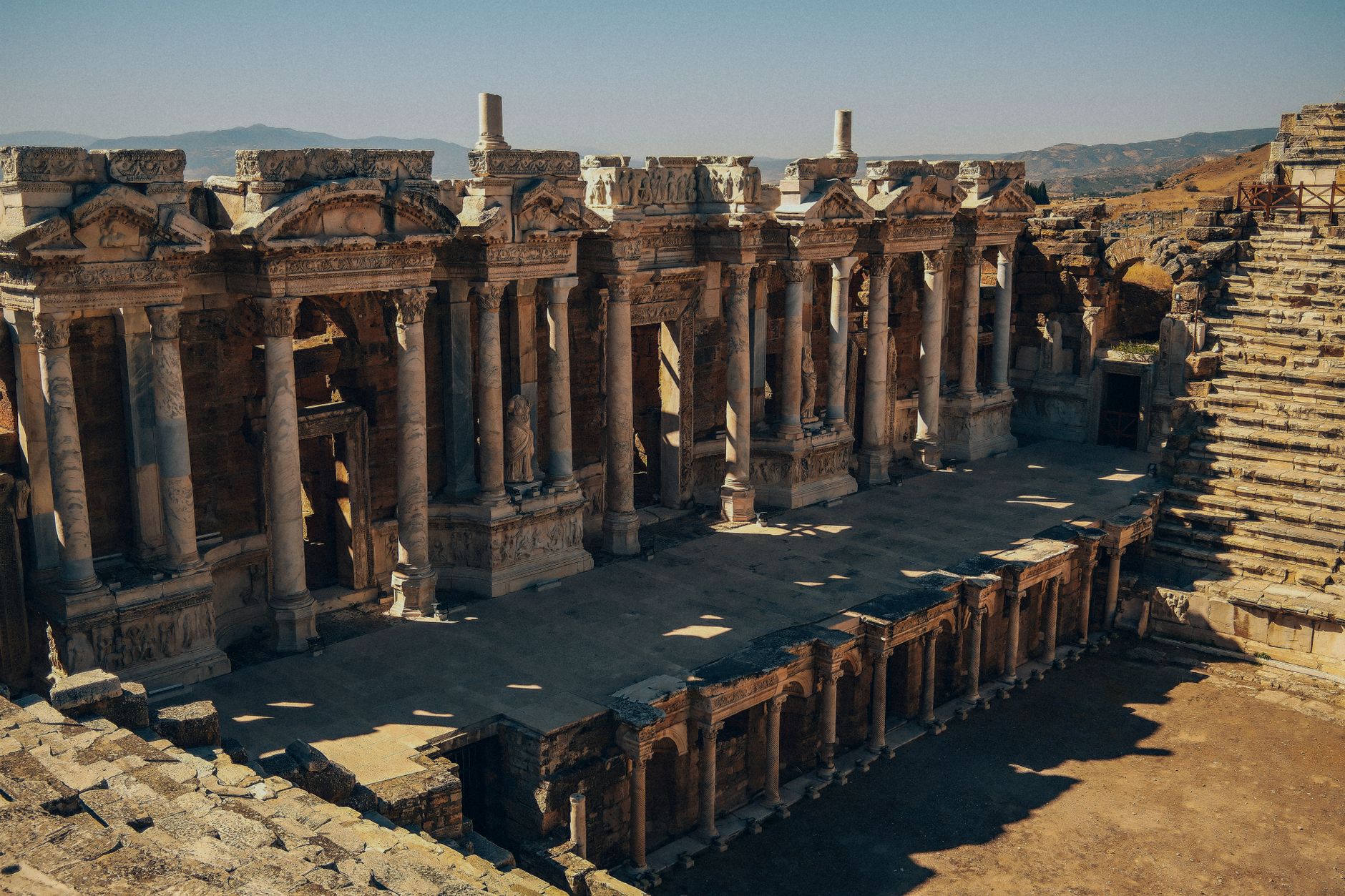
Hierapolis: A Theater in the Land of Thermal Springs
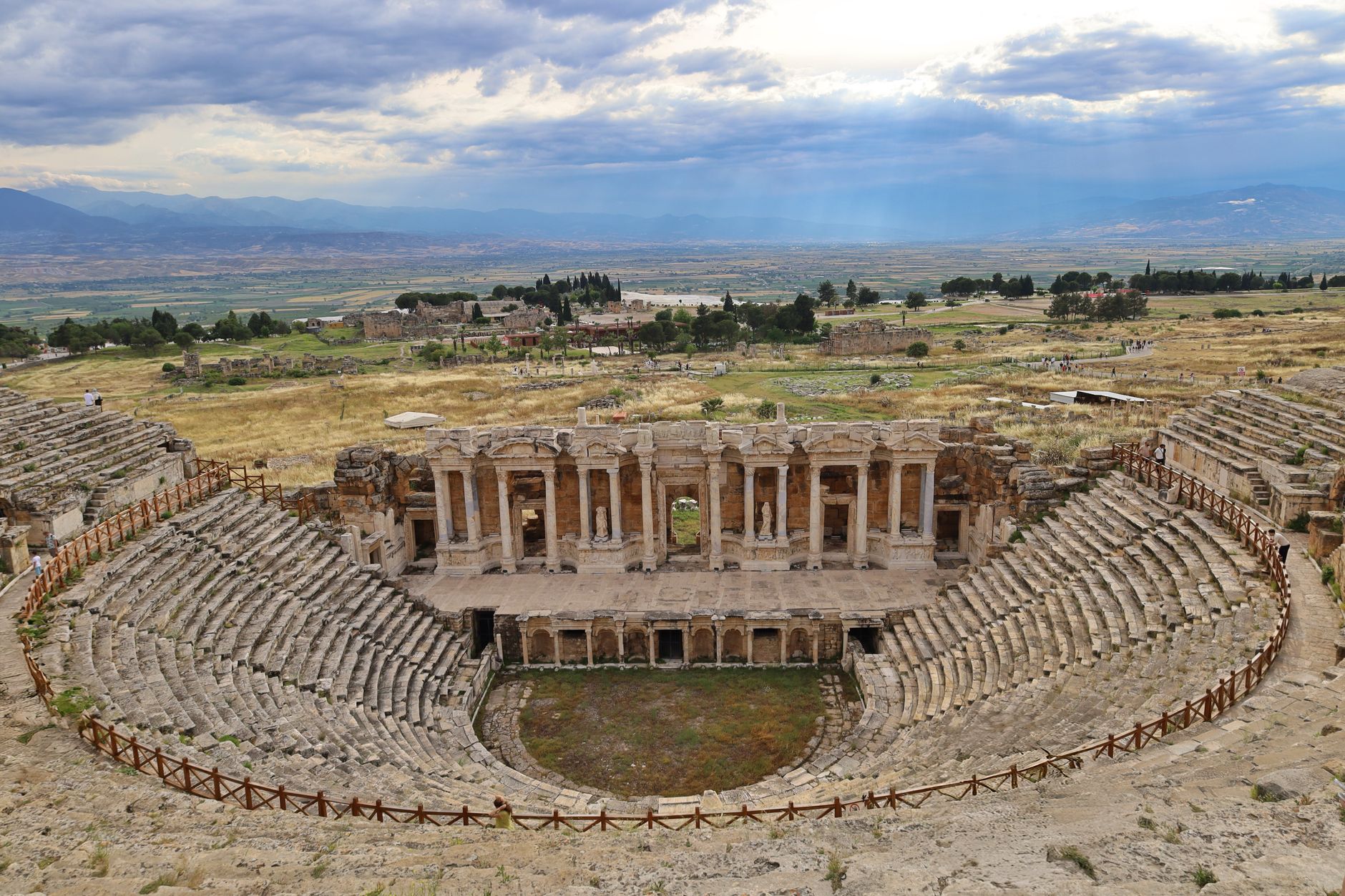
Perched on a hillside above the gleaming white travertines of Pamukkale, the Theater of Hierapolis is one of the most scenically dramatic in Türkiye. Its cavea was built in two phases, and its stage building is decorated with elaborate reliefs of Artemis, Apollo, and mythological scenes that have been painstakingly restored.
What makes Hierapolis special is the combination: you can spend the morning floating in the warm, mineral-rich waters of Cleopatra's Antique Pool — where submerged Roman columns lie beneath you — and the late afternoon watching the sun set over the theater and the cotton-white terraces below.
The theater here once seated around 12,000 and is part of the wider Hierapolis-Pamukkale UNESCO World Heritage Site. It also hosts occasional summer performances, though the real show is the setting itself: the theater seems to float above the travertine pools, with the Lycus Valley stretching to the horizon.
Best time to visit: late afternoon for golden-hour light on the travertines; bring swimwear for the antique pool. Tickets: a single ticket covers Hierapolis and Pamukkale; the antique pool charges an additional fee. Acoustic trick: stand at the center of the orchestra and sing a note — the reflection off the stage building and the hillside creates a natural reverb.
Termessos: The Eagle's Nest Theater of the Taurus Mountains
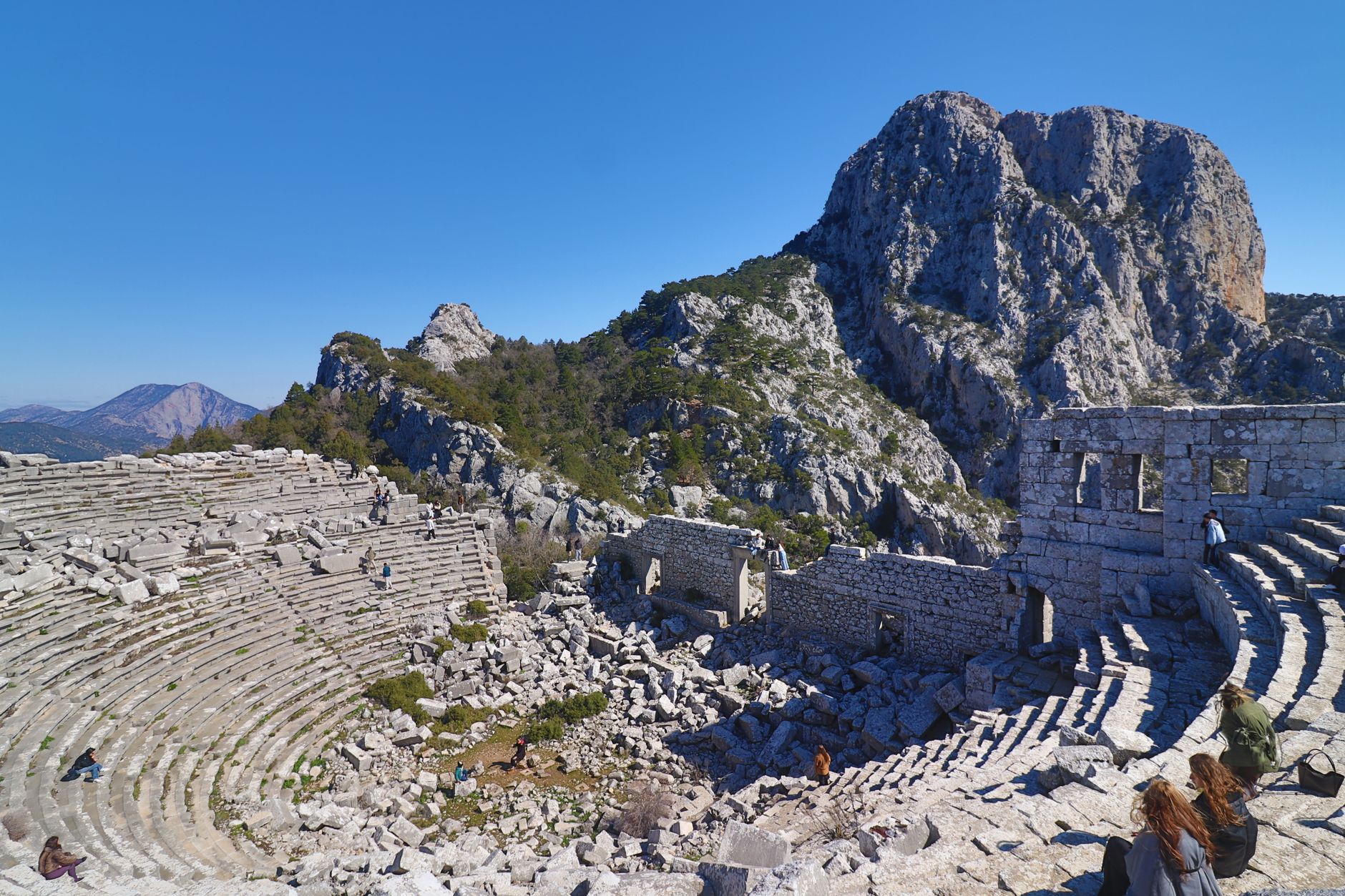
If the theaters of the coast are grand, Termessos is wild. This Pisidian city, high in the Taurus Mountains above Antalya, was never conquered — Alexander the Great himself failed to take it. Its theater clings to a mountain ledge at over 1,000 meters, with a sheer drop behind the stage and pine forests all around.
The theater at Termessos seated only about 4,000, but its setting is unmatched. The cavea looks out over a rugged gorge, and the silence is broken only by wind and birdsong. There is something profoundly moving about sitting here, imagining the ancient Pisidians watching tragedies in this remote, defiant city.
Termessos is also a haven for wildlife — the surrounding national park is home to wild goats, eagles, and the occasional lynx. The hike up from the parking area takes about 20–30 minutes and is steep and rocky, so wear sturdy shoes and bring water.
Best time to visit: spring (April–May) or autumn (September–October), when temperatures are mild. Tickets: a small national park entry fee at the gate. Acoustic trick: the open mountain air makes every whisper carry — try speaking from the top tier and have a friend listen at the stage.
Lesser-Known Gems: Priene, Miletus, and the Odeons of the Aegean
Beyond the famous names, Türkiye is scattered with theaters that see few visitors. Priene's theater, built into the slope of Mount Mycale, is a Hellenistic masterpiece with seats for 6,500 and a view over the Meander plain. Nearby Miletus boasts a massive Greco-Roman theater that once held 25,000 — its vaulted passages are still walkable.
Further south, the theaters of Pinara, Tlos, and Arycanda offer the thrill of discovery with almost no crowds. Arycanda, in particular, has a beautifully preserved odeon and a theater that seems to tumble down the mountainside. On the Black Sea coast, the theater of Amasya is carved into the rock beneath the Pontic kings' tombs — a sight unlike any other.
Odeons — smaller, roofed performance spaces used for music, poetry, and civic meetings — are everywhere. The Odeon of Ephesus, the Odeon of Herodes Atticus in Athens' shadow at Aphrodisias (technically a bouleuterion), and the charming odeon at Assos all reward a detour. These intimate spaces are where you can most easily imagine a single performer holding an audience spellbound.
Best time to visit: weekdays in shoulder season for these lesser-known sites; many have no queues at all. Tickets: often a few euros, or covered by the Museum Pass. Acoustic trick: in odeons, try the same coin-drop test — the enclosed space adds warmth and depth to the sound.
Practical Tips for Your Ancient Theater Tour
To make the most of Türkiye's theaters, plan around the heat and the crowds. Summer (July–August) is hot and busy, especially at Ephesus and Aspendos; spring and autumn offer ideal temperatures and softer light. Most sites open around 8:00 or 8:30 AM and close between 5:00 and 7:00 PM, with seasonal variations.
The Museum Pass Türkiye is your best friend: it covers dozens of sites, including many theaters, and pays for itself after a few visits. For individual theaters, entry fees range from free to around 400 Turkish lira for the most famous sites. Bring cash for smaller, remote sites where card readers may be unreliable.
Respect the ruins: never climb on the seating unless a path is clearly marked, and do not remove stones. Photography is generally allowed, but drones usually require permits. For summer festivals, book tickets months in advance — Aspendos opera nights sell out fast.
Finally, take the time to simply sit. The theaters of Türkiye are not exhibits; they are invitations. Listen for the echo, feel the stone warm under your hand, and let yourself imagine the music and drama that once filled these spaces. Two thousand years later, the show is still going on — and you have a seat.
Thinking about a trip to Turkey?
Share your contact details and a vetted local expert will follow up with a plan built around you — free, no obligation.